what do mutual funds do to prevent market timing?
Do Your Mutual Funds Outperform the Marketplace?

Source: Dilbert
Do you pick the best agile mutual funds? The ones that outperform yr after year? If you do, you are probably in the minority. That's not to say that you lot have a flawed selection process. On the opposite, you could have a wonderful system in place to cull the best funds. It's merely that the arrangement in its current form has the deck stacked against you.
Active common funds come in all shapes and sizes. They invest in every category imaginable across the various markets, geographies, sectors and investment styles. According to the Investment Company Found, the number of common funds worldwide increased to over 7,600 by the end of 2011 from simply 564 on 1980. You tin can also add to that a total of almost 1,200 ETFs (a number that rises with each new investment fad).
The sheer number of mutual funds makes information technology difficult to choose wisely. Most people assume that an increased number of choices allows you brand more informed decisions. However, enquiry shows that more and more choices can be debilitating. This is 1 of the reasons investors have such a hard time making the correct decisions.
Agile MUTUAL FUND PERFORMANCE
The probability of choosing the all-time active mutual funds is very depression because nearly of them fail to beat their benchmarks over multiple time frames. Here are some mutual fund performance statistics from Standard & Poors to consider:
- In 2012, for active U.Southward. stock mutual funds 63% of large-cap funds, 80% of mid-cap funds and 67% of minor-cap funds failed to outperform their alphabetize criterion.
- Over longer time periods the results aren't whatsoever better. For the iii year menstruation concluded 2012, 86% of large-cap funds, 80% of mid-cap funds and 67% of small cap funds underperformed. The five year numbers are 75%, ninety% and 83% of underperformance, respectively for large, mid and small-cap agile mutual funds.
Here is a table showing the one, 3 and 5 year operation of active common funds in each category at the end of 2012 :
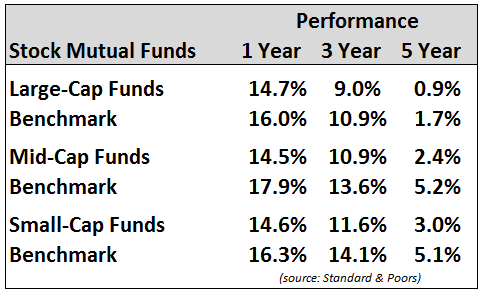
These are only U.S. stock mutual funds, but the functioning of stocks in global, international and emerging market funds was not much better. A similar pattern emerges for bond funds too. The one outlier was international pocket-sized-cap funds where the 1, 3 and v yr numbers showed only 15%, ten% and 21% of active funds underperformed their criterion.
For the majority of these numbers yous should notice that the number of active common funds that outperform gets lower every bit the period of fourth dimension lengthens. It gets harder to outperform the longer your fourth dimension horizon.
WHY ACTIVE FUNDS UNDERPERFORM
You would retrieve that the index (benchmark) would be the boilerplate render for a market because half of investors should outperform while the other half should underperform. That makes intuitive sense. But as yous can see from these render numbers this is definitely non the case. The indices are doing much better than 50% of all funds. The active mutual funds are getting routinely browbeaten over fourth dimension by elementary market indexes.
So why are the active manager results so poor when compared to a market index? There are a number of reasons, merely the biggest i is costs. Active mutual funds accuse much higher costs than unproblematic index funds. According to the Investment Visitor Institute the boilerplate annual fees on stock funds are 1.44% and bonds funds average i.02%. In comparison, all Vanguard funds average an expense ratio of simply 0.xix%. Most alphabetize funds offer similar low costs.
That'south a pretty big departure that the manager has to make upward through investing skill. There are many very good investors running mutual funds just over the long-term it tin be very difficult to make up that difference. One of the ways they try to do that is through more active trading. This increases transaction costs which make it even harder to beat an index fund (alphabetize funds merchandise infrequently, thus lowering costs).
Another reason is the law of large numbers. Here is Mr. Buffett'southward accept on how the size of funds affects investment performance (accent added):
" If I was running $1 million today, or $10 million for that matter, I'd be fully invested. Anyone who says that size does not hurt investment functioning is selling . The highest rates of return I've always achieved were in the 1950s. I killed the Dow. Yous ought to see the numbers. But I was investing peanuts then. It'southward a huge structural reward not to have a lot of money . I call back I could make you fifty% a yr on $one million. No, I know I could. I guarantee that. " – Warren Buffett
Most mutual funds don't start attracting money until they show good performance figures. But once they do have a solid performance record the coin really flows in. Having more coin is to invest makes it harder to discover worthwhile investments. That is what Buffett is telling usa in his quote. He could have higher returns if he was managing millions instead of billions. Once they striking billions in assets information technology is much harder for portfolio managers to exist nimble and notice the well-nigh inefficiently priced investments.
INVESTOR Beliefs
You tin find great mutual funds managers that will outperform their benchmark. It will just exist very difficult to do and so. Plus they are bound to have periods of underperformance which will make information technology harder to stay with them over the long haul.
One of the greatest mutual fund investors of all-time is Peter Lynch. From 1981 to 1990 his Fidelity Magellan Fund earned a 21.8% annual return versus the Due south&P 500'due south xvi.2% (still pretty solid) return. Simply the actual investors in his fund only earned xiii.4% in that time frame because of their poor timing of buying when the fund did great and selling when it did non do likewise. This is another unfortunate example of irrational investor behavioral wreaking havoc on investment results.
Add this all upwards and you will likely take improve performance over time investing in elementaryindex funds. Equally you can see from the performance numbers in a higher place, diversified, low cost index funds accept been a proven investment strategy over active common funds the bulk of the time. Why waste product your time trying to selection the best funds year afterward twelvemonth when you can play information technology safe and still outperform the majority of mutual funds out there?
Unfortunately, if your main source of retirement contributions is through a workplace retirement plan like a 401(k), you may not have the option to invest in a wide range of diversified alphabetize funds. The fund companies make much more money off of the expenses in their active mutual funds. You can observe alphabetize funds with a depression-cost fund provider by opening an IRA account but you all the same need to contribute to your 401(k), peculiarly if you are getting a company match.
For this reason I will have a follow-up post in the coming weeks with a process you tin use to pick active mutual funds if yous have to.
Sources:
Too many choices: A problem that tin can paralyze
Active managers lost again in 2012
Lessons from a great fund manager's record
Common fund fees are failing but still vary widely
Do you utilize active mutual funds, index funds or ETFs? Experience free to share your thoughts on your approach.
[widgets_on_pages]
Source: https://awealthofcommonsense.com/2013/04/do-your-mutual-funds-outperform-the-market/

Post a Comment for "what do mutual funds do to prevent market timing?"