How to Read and Meaning the Colors on the Legs of Canaries Birds
Canary Colours
Canaries bred and exhibited on the basis of color tend to be at the smaller end of the Canary scale, averaging around 140mm (five.5 inches). Equally in any bird, the colour is controlled by genes responsible for pigmentation. The many subtleties and combinations mean in that location are dozens of variations on the colour theme, and the key to understanding lies in the palette itself, and the wonderful results of pigmentation (or the lack of it). A wild Canary has three 'layers' of colour - an underlying yellow, turned partly green past the brownish melanin paint, and detailed with shades of black melanin.
Different Colour Factors in Canaries
- Melanin. The presence of melanin darkens colours, and in Canaries information technology is responsible for the blacks and browns. It can be present in varying degrees, and correspondingly different levels of variegation.
- Lipochrome (Ino-Factor). A lipochrome Canary lacks the blackness and brown 'layers', and is stripped dorsum to its base of operations color. In that location are three base types amongst pet Canaries – the classic yellow (Lutino), derived from the color nowadays in the wild Canary; the Red Factor (Rubino), whose rosy tint derives from a genetically imported red paint, the result of Due south American Reddish Siskins being introduced into the gene pool by cantankerous-convenance with Canaries; and white, in which base color pigments are lacking (Note: most white Canaries are not albinos, which lack pigmentation in their optics, pare, legs and nib, non just their feathers).
These five factors – black melanin, dark-brown melanin, lipochrome yellow, lipochrome red, and white – are the basis of the endless variations in Canary colour and plumage.
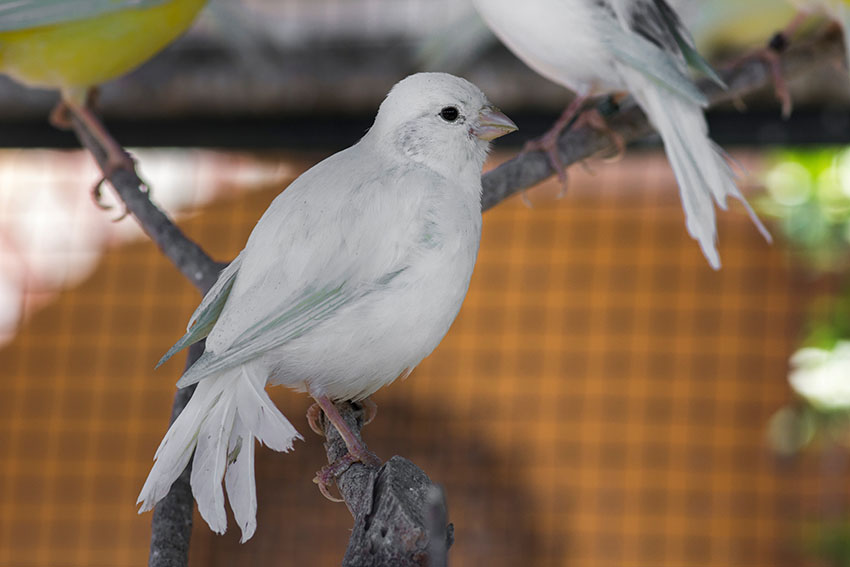
White Canaries
Canary Colour Variegation
The presence of melanin brings peachy variation to Canary colours and markings. Breeders categorise birds co-ordinate to levels of this pigment in the following way:
- Articulate. These birds take no melanin at all, and therefore no variegation in their colours.
- Self. The opposite to the Clear type, these all-melanin Canaries take no lipochrome colours (yellow or ruddy-based).
- Ticked. These have minor, localised patches of melanin.
- Foul. Undoubtedly the to the lowest degree flattering of the many tags given to pet birds, these accept a small number of light feathers in their wings or tail, on an otherwise dark glaze.
- Variegated. A grab-all category used for annihilation that falls between ticked and foul Canary types. A 'lightly variegated' bird has less than 50% dark feathers; a 'medium variegated' is between 50 and 75%; and a 'heavily variegated' has in excess of 75% dark coloration – only less than 100%.
Color Canaries for Shows
In terms of categorisation for show purposes, these are the main groupings of Canaries. (Note: these are non types equally such, as many of the categories can utilise to yellow or ruby-red-based birds, and they can be crested, uncrested, etc.)
- Dark-green (same colours as the wild Canary). These are birds with a yellow base colour and lots of melanin creating greens and blacks.
- Yellow Melanin. These have less pigment than Greens, resulting in a basically yellow bird with dark areas of plumage.
- Red Factor Melanin. These birds are the crimson versions of the Yellowish Melanin, with cerise instead of yellow every bit the base colour, forth with dark pigmentation.
- Yellow Lipochrome. These are the 'Tweety Pie' yellow birds that lots of people automatically acquaintance with Canaries.
- Cherry-red Gene Lipochrome. These are birds with no melanin, but with ruby cistron instead of yellowish, resulting in shades ranging from pinks and oranges to reds.

Pied red Canary
- Blue Factor. These Canaries have a white or yellow base colour, tinted past a trick of the calorie-free (rather than a darkening past melanin). This may sound odd, simply birds' plume hooklets often reverberate light in such a way equally to produce the appearance of colours - the dark-green and regal tinges seen on starlings and magpies, for instance. In yellow Canaries the effect is green; in white birds the effect is a bluish grey.
- Silver Factor. These are like to the Blue factors, but with less melanin, and hence a washed-out, silvery sheen to their feathers.
- Ascendant White and Recessive White. These 2 birds await similar, the differences beingness in the dominant or recessive nature of their genes. Their feathers lack melanin and lipochrome, resulting in a white bird. They have dark eyes, dissimilar an Albino bird.
- Pastel Gene. Known equally 'dilute factor', melanin is reduced in these birds, making the plume a pastel shade.
- Ivory Factor. Another 'dilute factor' type, all pigmentation is reduced in Ivory birds, washing out the colours to varying degrees.
- Opal Factor. Opal Canaries conduct two sets of a recessive gene that dilutes melanin, making blacks greyness and washing out the browns.
- Cinnamon. Black pigmentation is absent in Cinnamons, which sport browns on a yellow base.
- Fawn. These are like the Cinnamons, but with a white base and not a yellowish ane.
- Agate. In Agates it is the chocolate-brown pigment that is lacking, leaving the blacks and greys to color the bird.
- Isabel. This type has both black and brown pigments at work, only results in birds singled-out from standard Green, Yellowish and Red types.
- Satinet. These Canaries have localised pigmentation only, on the back and flanks.
- Albino. As in any other animate being, an albino Canary lacks all pigmentation. This ways white feathers and pinkish skin, optics and legs. Due to the complexities of genetics, some albino Canaries (ones with a dominant rather than recessive albino gene) take a hint of yellow about the shoulders and the edges of their flight feathers. They tin also have dark instead of pinkish eyes.
- Ino. These are another reflection of the complexities of genetics, having an essentially albino makeup, but with dark ruby-red eyes and some pigments present.
- Phaeo. These Canaries have no blacks or greys nowadays, and their brown pigment is concentrated on the edges of the feathers.
- Onyx. This is a very dark bird with lots of black paint and no browns to lighten the effect.
- Eumo. These lack brown paint, as in the Onyx, but the bird has less black pigment, resulting in a much lighter 'dark' bird.
- Pied. This general term refers to a bird with areas where the base of operations colour is absent-minded (due east.thousand. white patches behind the yellowish or blood-red), and/or with localised splashes of pigment.
- There is also a Dimorphic Factor gene that tin can complicate the colours by making cocks and hens of each type different.

Pied scarlet Canary
This list isn't the finish of the story, but it covers the bones ground upon which other genetic variations are built.
Source: https://www.omlet.co.uk/guide/finches_and_canaries/canary/colours/

Post a Comment for "How to Read and Meaning the Colors on the Legs of Canaries Birds"